
Dots Infra, RedNote
Aug 2025 – Jun 2026Research Intern, LLM Training Infrastructure
Ph.D. Candidate in Computer Science/Peking University
I am a final-year Ph.D. student in Computer Science at Peking University, advised by Prof. Guojie Luo at the Center for Energy-Efficient Computing and Applications (CECA). I received my B.S. in School of EECS, Peking University in 2022.
I build machine learning systems, optimizing the full stack — from heterogeneous hardware to large-scale distributed systems — for efficient and scalable LLM training and inference. My recent focus is rack-scale systems (aka “超节点”) that carry production deployment of trillion-parameter MoE models, alongside large-scale RL systems and efficient multimodal models. Earlier, I worked on parallel acceleration and efficient algorithms for design automation.

Research Intern, LLM Training Infrastructure

Research Intern, LLM Reasoning and Autoformalization

Research Assistant, Computer Architecture and Systems
Awarded the Tencent Hunyuan Ph.D. Fellowship (中国电子学会-腾讯博士生科研激励计划·混元大模型专项)
We open-source UltraEP, a production-ready expert load balancing library
Our real-time expert load balancer for large-scale MoE training and inference, running in production with near-optimal balancing, is now public. Read more

Preprint 2026
Expert load imbalance caps MoE training and inference throughput under large-scale expert parallelism. UltraEP is the first balancer to act on exact post-gating load in real time — replicating hot experts and rerouting tokens inside every layer of every microbatch — holding critical-path cost under 300 µs and reaching 94.3% of the force-balanced ideal throughput.
Preprint 2026
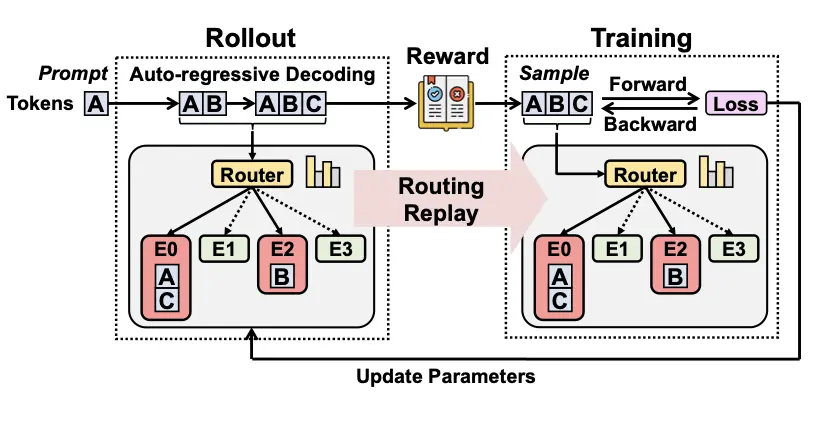
MoE RL shows significant expert load imbalance: its data is domain-skewed and load distribution swings hard. ReLibra leverages the replay of routing decisions already observed during rollout to plan balancing ahead of time for the RL training phase.
Preprint 2025
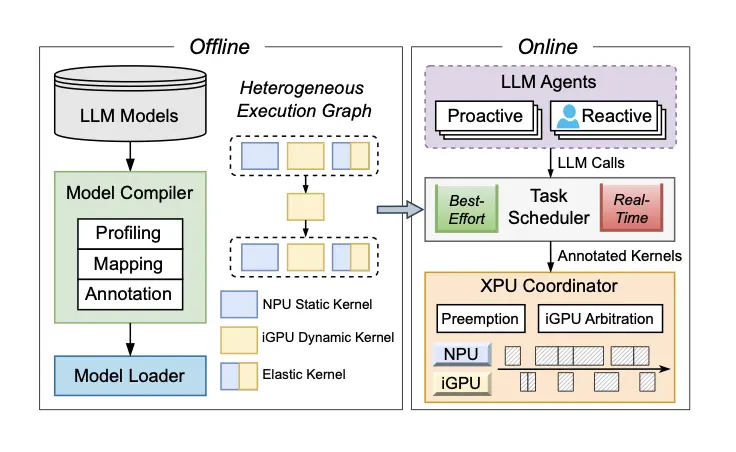
Agentic workloads put latency-critical turns and throughput-bound background work on the same heterogeneous SoC. Agent.xpu unleashes NPU and GPU with phase disaggregation and elastic tensor chunking, adds kernel-level preemption with slack-aware piggybacking, and dispatches kernels with bandwidth awareness, keeping interaction responsive without leaving accelerators idle.
ICCAD 2024
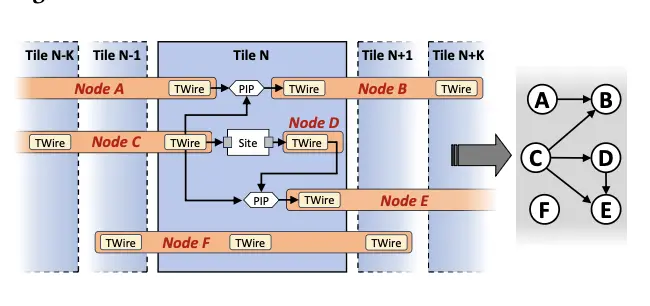
FPGA routing is essentially node-disjoint path finding on a DAG, where congested regions blow the search space up exponentially. AceRoute pairs adaptive bidirectional A* with fine-grained intra-connection parallelism and a lock-free multi-threaded runtime for substantial speedups.

IEEE S&P 2024
Outsourced fabrication lets a foundry slip hardware Trojans into a finalized layout. SiliconCritic reproduces black-box, foundry-level attacks and post-fabrication analysis at design time, quantifying insertion difficulty from the resulting shifts in timing and power side channels.
DAC 2023
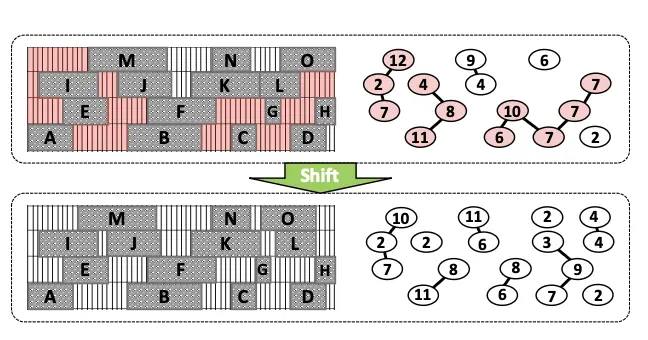
Hardening a layout against Trojan insertion normally costs timing. GDSII-Guard frames it as ECO-style incremental edits over a connected-graph layout representation, using greedy cell shift, clustering and wire scaling to walk the security–performance trade-off.